Advertisement
Supported by
America Is Not Made for People Who Pee
As Biden pushes for an infrastructure package, let’s fix our scandalous lack of public restrooms.

Opinion Columnist
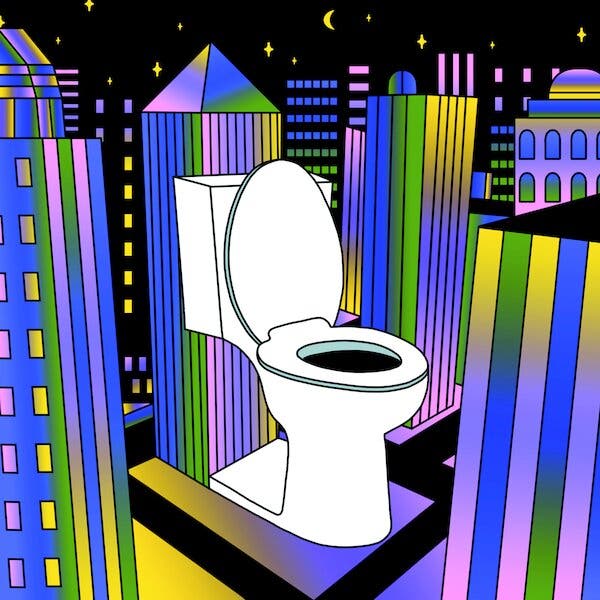
PORTLAND, Ore. — Here’s a populist slogan for President Biden’s infrastructure plan: Pee for Free!
Sure, we need investments to rebuild bridges, highways and, yes, electrical grids, but perhaps America’s most disgraceful infrastructure failing is its lack of public toilets.
Greeks and Romans had public toilets more than 2,000 years ago, with people sitting on benches with holes to do their business. There were no partitions, and Romans wiped with sponges on sticks that were dipped in water and shared by all users.
I’m not endorsing that arrangement, but at least the ancient Romans operated large numbers of public latrines, which is more than can be said of the United States today.
The humorist Art Buchwald once recounted an increasingly desperate search for a toilet in Manhattan. He was turned down at an office building, a bookstore and a hotel, so he finally rushed into a bar and asked for a drink.
“What kind of drink?” the bartender replied.
“Who cares?” Buchwald answered. “Where’s the men’s room?”
America should be better than that. Japan manages what may be the world’s most civilized public toilets — ubiquitous, clean and reliably equipped with paper — and almost every industrialized country is more bladder-friendly than America. Even poorer countries like China and India manage networks of public latrines. But the United States is simply not made for people who pee.
“I go between cars or in bushes,” Max McEntire, 58, who has been homeless about 10 years, told me as he stood outside the tent where he lives here. “Sometimes at my age, if your body says pee, you’ve got to pee. If your body says poop, you can’t wait.”
Most stores and businesses are of little help, he said, because they often insist on a purchase to use the restroom — and that’s even before a pandemic closed many shops.
“At night you’ll see men and women pulling their pants down and peeing and pooping in the gutter,” McEntire said. “People lose their dignity, they lose their pride.”
Cities also lose their livability, and open defecation becomes a threat to public health. Americans have painstakingly built new norms about dog owners picking up after their pets, but we’ve gone backward with human waste.
Meanwhile, it’s not just the homeless who suffer. Taxi drivers, delivery people, tourists and others are out and about all day, navigating a landscape that seems oblivious to the most basic of needs. The same is true of parents out with kids.
In Ferguson, Mo., Walter and Ritania Rice took their children to a city park. Their 2-year-old son needed to pee, there was no toilet around, so Walter Rice took his son behind a bush, where the Rices’ 4-year-old urinated as well. A police officer arrested Rice for child neglect, and he was held in jail for nine hours and later found guilty by a judge.
And in Piedmont, Okla., a police officer gave a 3-year-old boy a $2,500 ticket for public urination, even though the incident occurred on private property. After an outcry, the officer was fired; instead, I suggest he should have been given a couple of extra-large coffees and ordered to spend his shift monitoring a playground with no toilet.
What’s a parent supposed to do when a toddler needs to wee? And what about people with medical conditions that require more frequent urination or defecation? Why do we make life so difficult and humiliating? How is it that we can afford aircraft carriers but not toilets?
For men, it’s more convenient to disappear behind a trash can, but men also face greater risk of being arrested — and the consequences can be dire. At last count, 13 states sometimes classify people arrested for public urination as sex offenders.
In Florida, a welder named Juan Matamoros was fined and ordered to move away from his home, which was near a park, because 19 years earlier he had been arrested for public urination; as a result, he was considered a lifelong sex offender and not allowed to live near a park.
Women seem less likely to be arrested but more likely to be humiliated.
“It’s a big hit to your dignity the first time you have to squat down in a field or by the side of the road,” said Raven Drake, 37, who until recently was homeless and now works with Street Roots, a Portland group supporting the homeless. “Slowly you take these hits to your dignity, and one day you don’t even think you’re a person anymore.”
Drake told me that she had lived in a homeless encampment in Portland that was two miles from the nearest restroom she could use, and she flinched as she recounted the shame of having to relieve herself where she could, trying to avoid people leering. Toilets, she said, are an infrastructure issue, but also far more than that: “Bathrooms are a humanitarian issue.”
In the 19th century, the United States did set up public toilets in many cities. They were often called public urinals, abbreviated as P.U. (this may be part of the origin of “P.U.” to mean something that stinks, although there are competing theories). In the early 20th century, these were supplemented by “comfort stations” for men and women alike, but most closed in waves of cost-cutting over the years.
That’s partly because this is a class issue. Power brokers who decide on infrastructure priorities can find a restaurant to duck into, while that is less true of a Black teenage boy and utterly untrue of an unwashed homeless person with a shopping cart.
Granted, operating toilets is tough. American cities have experimented with various approaches to providing public restrooms and found that they are costly to maintain and sometimes attract drug use and prostitution. Still, no one would build a home today without a bathroom, even though it adds to the expense. So why economize and accept cities without lavatories?
Americans have had tumultuous debates about transgender use of restrooms, but we haven’t adequately acknowledged a more fundamental failing in Democratic-run and Republican-run cities alike: the outrageous shortage of public restrooms generally.
The White House can work with cities to experiment with various approaches to expand restroom access. We can work with corporate sponsors. We can use advertising to help underwrite the expense. We can give tax breaks to businesses that make restrooms open to all. There are models all over the world, such as India turning old buses into clean public toilets.
If the Romans could figure this out two millenniums ago, surely we can, even if we’ll want to skip those shared sponges.
So come on, President Biden! Let’s see an infrastructure plan that addresses not only bridges and electrical grids, but also bladders and bowels.
The Times is committed to publishing a diversity of letters to the editor. We’d like to hear what you think about this or any of our articles. Here are some tips. And here’s our email: letters@nytimes.com.
Nicholas Kristof has been a columnist for The Times since 2001. He has won two Pulitzer Prizes, for his coverage of China and of the genocide in Darfur. You can sign up for his free, twice-weekly email newsletter and follow him on Instagram. His latest book is "Tightrope: Americans Reaching for Hope." @NickKristof • Facebook









Most Popular
3 Alabama Professors on Leave After ‘Offensive’ Halloween Photos Surface
More Than You Need to Know About Harry, Meghan and Oprah
The Times Is Adding Disclosures About David Brooks’s Outside Work to His Columns
U.S. Prosecutors Call Him a Murderer. To Ukraine He’s an Asylum Seeker.
Texas School’s Lesson on Chivalry Asked Girls to ‘Walk Daintily’ and Obey Men
Jean Kennedy Smith’s Duplex Is Up for Sale
These Gay Men Frequented Manhattan Piano Bars. So Did Their Killer.
A Road Trip That Ended in Love
Watch These 13 Titles on Netflix Before They Leave This Month
In Iceland, 18,000 Earthquakes Over Days Signal Possible Eruption on the Horizon
Advertisement
Comments 1608
America Is Not Made for People Who PeeSkip to CommentsAnyone who has ever been on an extended road trip deals with an even greater dearth of public restrooms. Interstates might have a rest area with facilities that are open every 50 miles or so. Or not. Truck stops are even further apart than that, usually 100 miles or more. And I won't even get into the fraught adventures we've had at some of them. Get off on the state highways and it's even worse. Which necessitates pulling off on a dirt road, probably with not even a small bush to hide behind. Or perching beside the car with the door open when a cattle truck comes barreling down said dirt road, the driver looking right at me. And if one is traveling with children, well, it's exponentially worse. We finally bought a travel trailer.
I am blessedly not homeless, but I do carry a plastic urinal with me in the car when I'm out for any length of time, along with a big towel to cover myself with if and when I need to use it. This has become even more critical during pandemic, when I wouldn't use a public restroom even if there were one.
Europeans don’t understand why American restrooms have almost 2ft of clearance on the bottom, what happened to some privacy? Conversely, Americans don’t understand why not even the department stores and supermarkets in Europe have any restrooms. Clearly, we can learn a few things from each other in our rekindled transatlantic relationship.
A sympathetic lady once gave me her empty coffee cup for a desperate little boy when the subway was stuck interminably between stations for mysterious reasons. Many New Yorkers have mass transit commutes of over an hour with no restroom access. I’m betting a lot of us time our coffee strategically.
I love to drink at least two large cups of tea in the morning, but when I’m travelling as a tourist, I am often afraid to drink any tea with breakfast at my hotel, in case I can’t find a public restroom afterwards- including in my home country of France. When I visited Japan for the first time I found it almost miraculous that there was always a spotless public lavatory within a couple minutes walk. Not having the nagging fear and constant worry of having “no place to go” made visiting that lovely country infinitely more enjoyable- particularly as a woman. We can and must do better.
Having worked in restaurants for years, I saw the ladies’ and men’s rooms at the end of the evening. These were fine dining establishments. Every night it was the same. Disgusting. And this was after busboys had cleaned them several times during the evening. The ladies’ rooms were usually worse, frankly. The Japanese have high standards when it comes to cleanliness and respect for “the next person.” Not so here. I don’t know why this simple courtesy isn’t instilled in so many citizens of the US. I always feel terrible for those who clean up after us. They are charged with a stomach-turning, demeaning task, which could endanger their health! If you could find a way where restrooms are self-cleaning, I’d be thrilled to have more of them for the homeless as well as people out and about or driving from place to place. Many other countries are way ahead of us in dealing with this human need.
Our town, in the midcoast of Maine, is, as we write, constructing a public toilet facility in the town's public waterfront parking lot. Such facilities are common along the coast of Maine and other places where tourists are likely to gather. In Hawaii, all public parks have open and accessible toilet facilities, and near the beach, showers to get rid of the sand and salt water. Neither place sees this as a particularly difficult thing to do... so what is wrong with other states? And big cities? Anyplace that wants tourist traffic should have public toilets. Other places should provide them out of a sense of decency, and human necessity.
As a 78 year old man with diabetes, I often find that I cannot go out for more than an hour without having to find a restroom. Too often, even those one can find, are filthy and unsanitary. When I was a kid, my mom looked for a Standard Oil service station who always had a sandwich board sign out front "Clean Restrooms." Forget about prices, clean and sanitary rest rooms were of number one priority. Your better class restaurants pride themselves in superior rest rooms (but many run of the mill cafes and bars fail the smell test). It is certainly a sign of depraved times to see so few public facilities for those who are "bladder challenged" or "suddenly caught short" as my dad would say.
Even in suburbia it’s an issue with a surprising “solution”. A new home construction site near my home on our small cul de sac has a port-a-potty on the curb for the construction crew to use. Every day I see Amazon drivers and other delivery trucks stop there to use the -ahem- “facilities”. In the dead of winter, temps well below freezing. I believe that it has become a known “destination” among drivers with far more delivery trucks stopping there than would ever be on our short street. It’s like a secret private club all the drivers know about.
The first thing I noticed about American cities ( l Live in Newark, NJ frequently go to NYC, just across the River) was the absolute lack if public toilets. The first thing I notice about European cities, especially in Central Europe, was accessibilty to same. You might have to tip someone 60 cents, they keep facilities spotless and safe