
“Christmas time, mistletoe and wine” sings Cliff Richard. It’s one of the many songs you can hear in shops during Christmas time in Poland and England alike.
However, the Christmas songs is probably one of the few things that
Poland and England have in common. Christmas is celebrated in quite a
different way in Poland. And ever since I moved to England, I have been following my Polish roots, which initially caused quite a stir among my British friends 
So what are those differences between Christmases?
Because Poland and England (if not the UK) have got completely different histories, the culture and customs are also quite dissimilar. So let’s look at Christmas in Poland and England.
24th vs. 25th December
Let’s start with the date. The Polish celebrate the main Christmas event on the evening of the 24th December. The main dinner, presents, and celebrations happen on Christmas Eve.
Why? Because we celebrate the birth of Jesus, and he was born – according to the sources – in the evening, or at night.
Looking for the first Christmas star
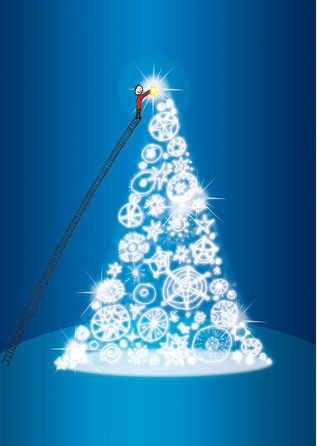
The littlest kids (that includes me and my sister while we are well passed our 30s too!) are tasked with spotting the first star in the Christmas sky.
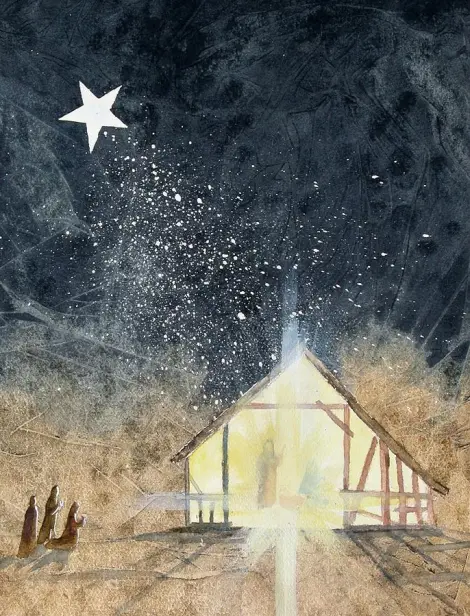
The star symbolises the one that guided the wise men to the place where Jesus had been born. This means that if you can see the first star, it’s time to start the Christmas celebrations.
Sharing Christmas Wafer
Once all the kids, big and small, spotted the first star, we gather together and share the Christmas wafer.
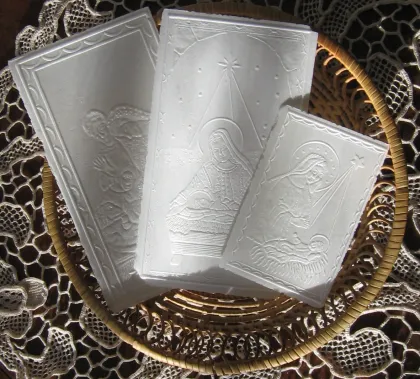
It’s similar to the communion you receive during a church mass, only it’s bigger and prettier. It’s got scenes from the Bible relating to Christmas embossed in it. I always first feel guilty of eating it because the wafers are quite beautiful.
We share the wafer with everyone who has come for the Christmas
celebrations. This is our moment to share our Christmas wishes for the
next year with our family, and all dogs and cats and other rabbits
And finally – Christmas dinner
In the olde days, you would be expected to fast the whole day until Christmas dinner. I think now it’s kind of still in place, but not necessarily everywhere.
If a family does observe it, then everyone is properly famished by the time the Christmas dinner can be eaten.
So here is the biggest “are you for real?” I always get: the Polish don’t eat turkey for Christmas.
Following the Christian tradition, we eat fish, and more specifically – a carp. It is by far one of the best dishes you can ever eat in Poland. My mother makes it with raisins, and the taste is simply divine.
In theory, there should be 12 dishes prepared for Christmas dinner – because of 12 apostles. Ages ago, the Polish mothers would kill themselves to make sure there were 12 dishes on the table. It was the matter of honour to prepare a lavish Christmas dinner.
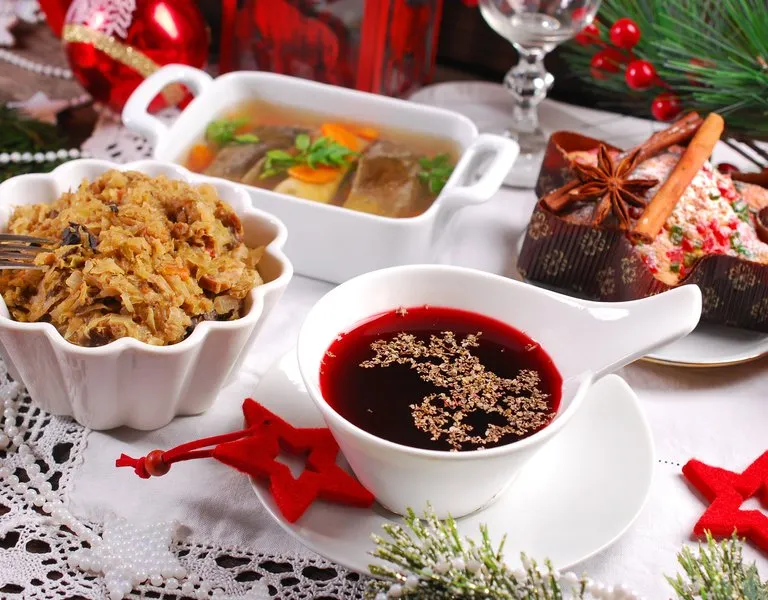
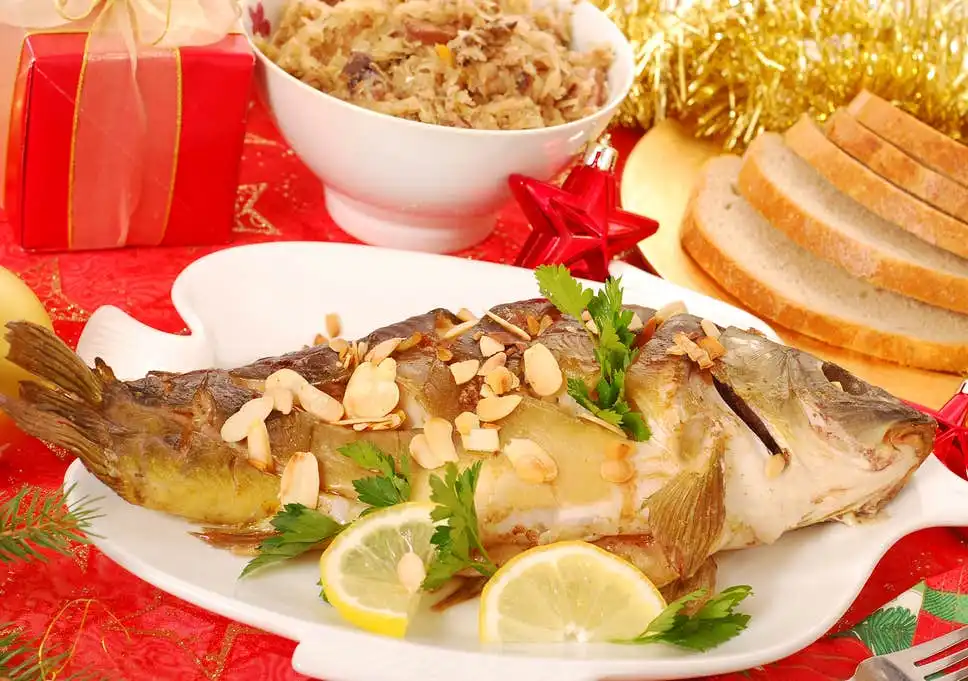
Nowadays, fortunately, people modify this tradition a little to make for healthy choices, and to simply not waste food.
I can tell you what’s usually on the table in my family: a beetroot soup with dumplings, the carp, boiled potatoes, sweet cooked cabbage (yummy!), red cooked cabbage (yummy too), noodles with poppy seeds and honey (we call this Makielki), and drink made of dry fruit.
There would also be a cake or two, if you happen to still have any space left in your stomach after eating all this!
The tradition that I particularly like is that we leave one empty seat. In case a stranger knocked on the door, hungry and cold, there is a place already prepared for them. Do other nations do that too?
Time to open Christmas presents
We open Christmas presents on the 24th December as well. The tradition has it that you are allowed to open the presents if all the food has been eaten off your plate – but I think it’s just to get the kids to eat their greens.
Because the presents opening happens on the 24th, it’s sometimes
tricky to put them under the tree without being spotted. However, I see
it as a chance to perfect your ninja skills
Christmas in Poland – the Midnight Mass
If you’re brave enough, and not falling asleep, you can attend the Christmas midnight mass. Brave – because it’s always incredibly cold. Not just because of the winter and snow, but because the church is likely to be freezing!
I actually have never attended this midnight mass. Or at least I don’t have a recollection of attending one. Maybe my parents took me when I was younger. I do know, though, that it is quite an event with Christmas carols being sang, and a very festive atmosphere all around.
All of the above is what happens on the 24th December. Quite a different way of celebrating Christmas to the British one, isn’t it?
The 25th December is for visiting the family that hasn’t joined you for the Christmas Eve. This is when the Polish people flood cities and towns to get from place to another. The 26th is usually for catching up with friends. Some people may choose to visit cemeteries to ‘celebrate’ Christmas with those that are gone.
Let’s play fortune-telling
One last thing: because Polish culture also has pagan roots, there
are some traditions that are celebrated around Christmas that have got
nothing to do with Jesus and Christianity or Catholicism. My favourite
is telling the future using dry hay
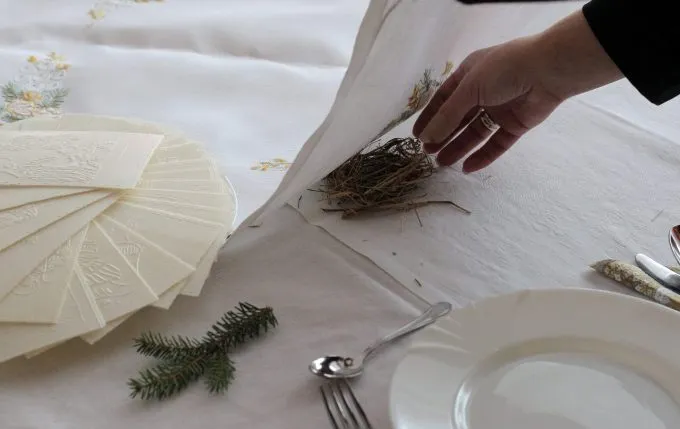
You put some dry hay underneath the table cloth where you’ll be eating your Christmas dinner. After the dinner, each person pulls one hay blade from underneath the table cloth and examines it. Is it broken? Is it long and thick? Or maybe it’s bent? You can use your wizardly skills and try to tell what each blade tells about your next year. My mother is often quite adamant that the blades DO tell the future. The rest of us naturally take it with a pinch of salt
And how do you celebrate your Christmas? Do you have any traditions that your family has been following for years?
Most importantly, have a lovely and loveful Christmas! May the Good Vibes be always with you


Pingback: Living Abroad: British and Polish food - Good Vibes Spreader
Pingback: Easter in Poland - eggs, bunnies, and more eggs - Good Vibes Spreader
Pingback: Living Abroad - the Beauty of Culture Shock - Good Vibes Spreader
Pingback: How I celebrate my Polish Christmas in England - Good Vibes Spreader